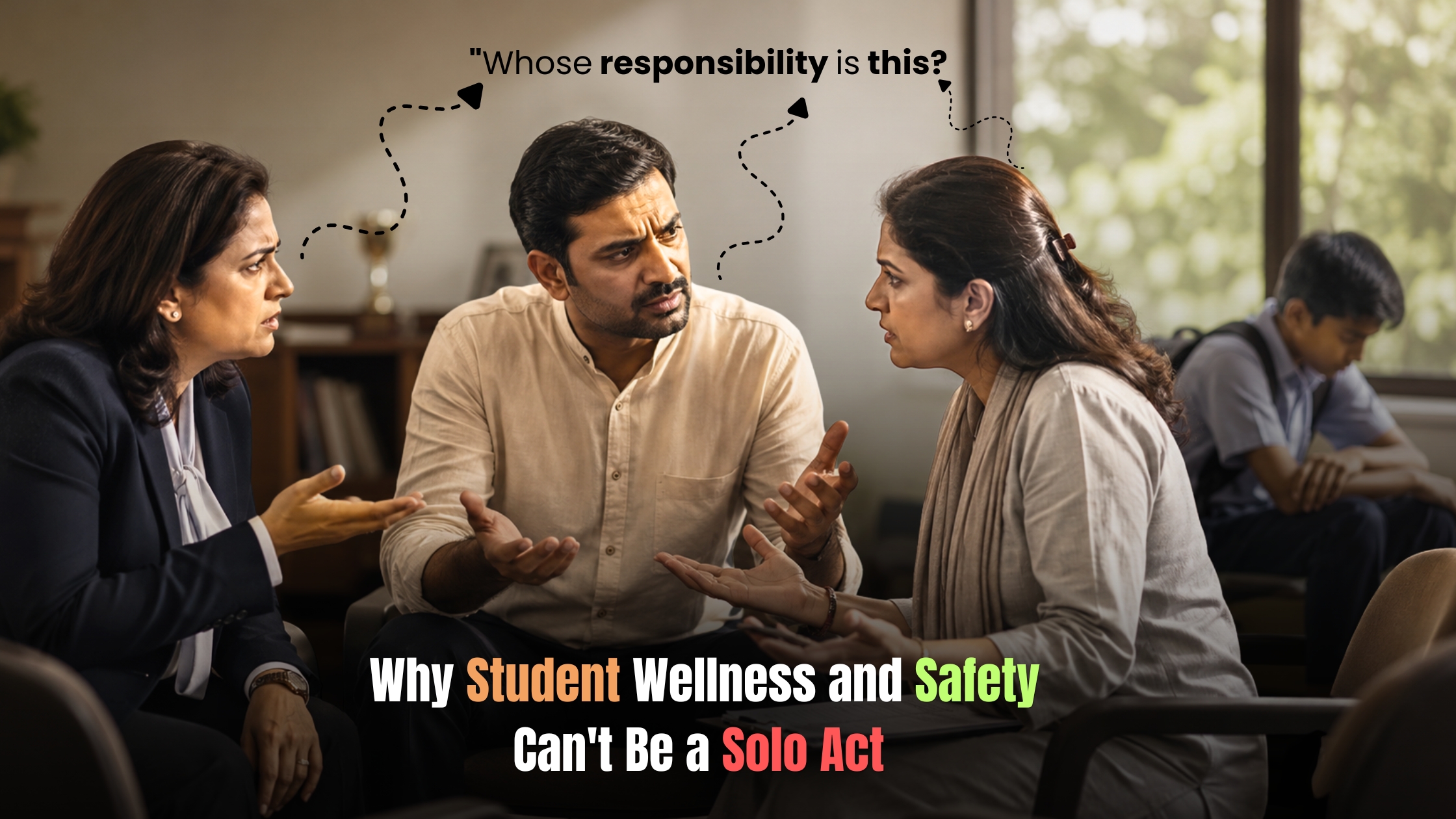
Ask any parent whose child is going through a rough patch — "Whose responsibility is this?" Nine times out of ten, the answer is some version of passing the parcel. Parents look to schools. Schools look to counsellors. Counsellors look at overstretched calendars. And the kid in the middle? Often suffering in silence.
Our own focus group with mothers across DPS Gurugram, DPS Vasant Kunj, Shiv Nadar School and DPS 45 confirmed it. When asked who a distressed child would approach first, 29% said "no one." Only one parent in the entire survey thought their child would go to a teacher.
That's not a school problem. That's not a parent problem. That is a system problem.
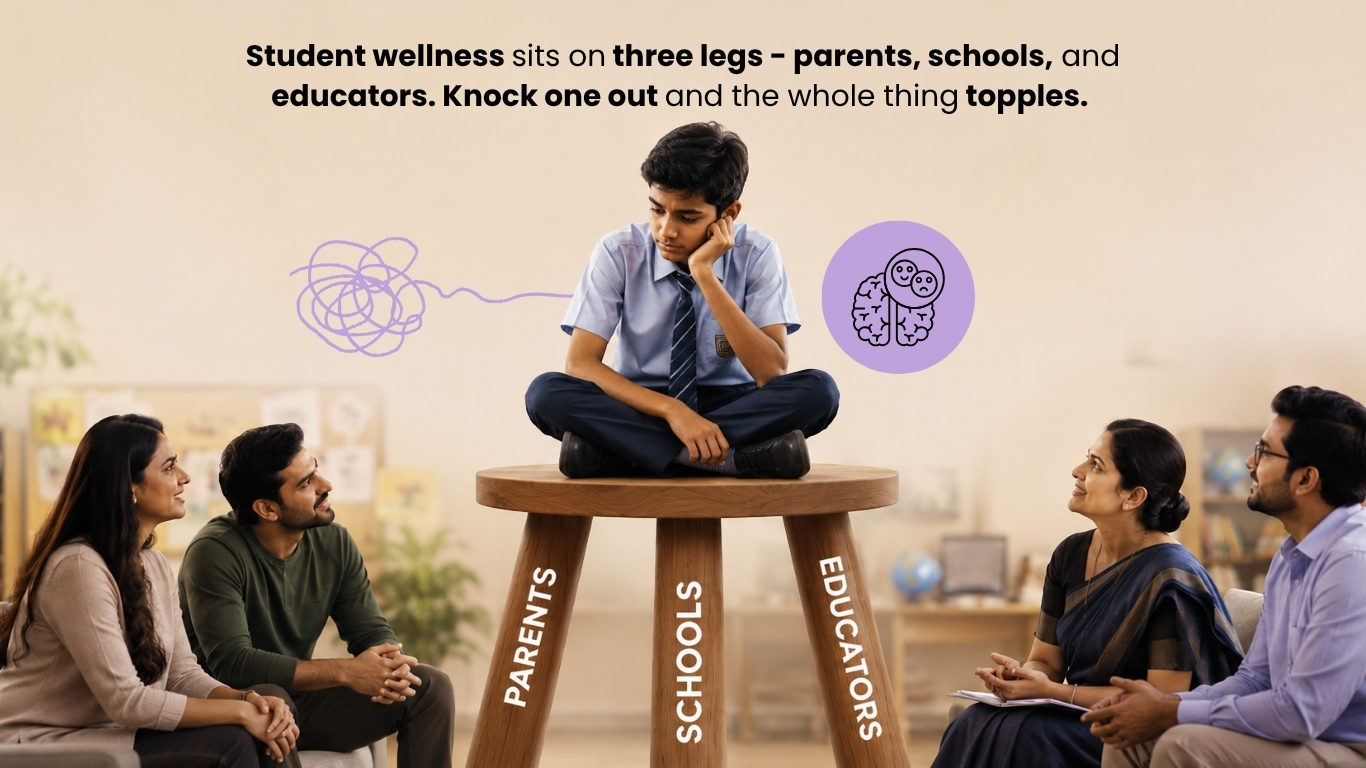
The Three-Legged Stool
Student wellness sits on three legs — parents, schools, and educators. Knock one out and the whole thing topples.
Parents see the child at home — their sleep patterns, their appetite, their friend group, and their screen-time spirals. They have history. They know what "normal" looks like for their kid.
Schools see the child in their natural habitat with peers — academic stress, social dynamics, the unwritten classroom hierarchies. Teachers spend over 1,000 hours a year with their students, often more waking time than parents during school weeks.
Educators get a firsthand look at the academic strains, the intricacies of student friendships, and the subtle social hierarchies.
Each one sees a different slice of the same kid. Nobody sees the full picture on their own.
So, Where Does It Break Down?
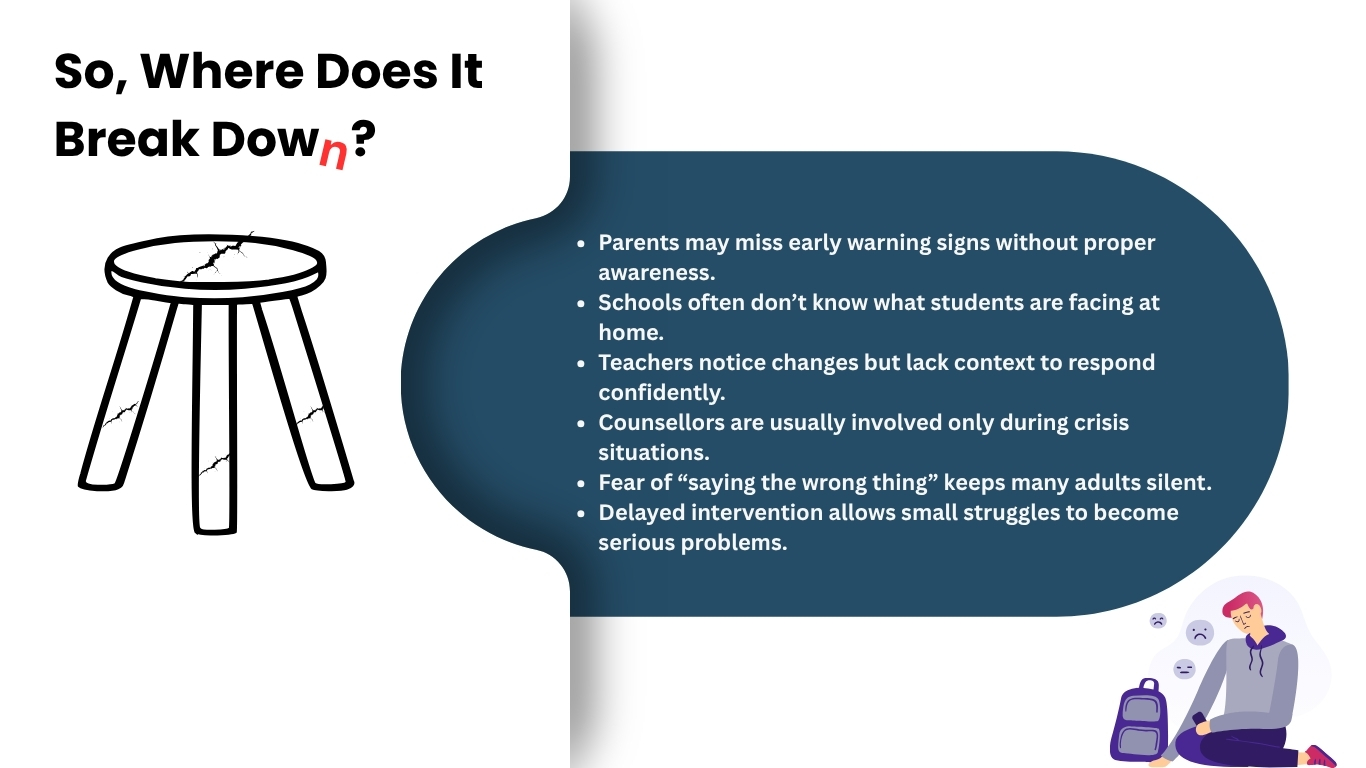
Parents don't know what they don't know. Your child stops eating breakfast. Big deal or symptom? Without training, it's a coin toss.
Schools are flying blind on home life. A teacher notices a student withdraw from group projects. Bad week at home? Bullying incident? Something deeper? Without context, the teacher's hands are tied.
Educators get pulled in too late. By the time a counsellor is called, it's already crisis mode rather than prevention mode.
The kicker — 86% of the parents we surveyed said teachers don't speak up about mental health because of "fear of saying the wrong thing." So even when adults notice, they freeze.
Meanwhile the numbers keep screaming. 13,892 student suicides in 2023. That's roughly one every hour. A 65% jump over the decade.
Stitching It Together
 You can't repair a broken stool by just replacing one leg. You need all three working in sync. Which is precisely what we built SWISS to do — and why the My Safe Spaces app lives on the parent's phone, not the school's server alone.
SWISS does the institution's bit. Five non-negotiable pieces — Teacher Gatekeeper Certification, Quarterly Teacher Labs, a Policies Toolkit, a trained Wellness Council, and 24/7 Crisis Response for certified schools. Schools stop guessing and start operating to a standard.
The My Safe Spaces app does the parent's bit.Family journals are the piece nobody talks about but everybody needs. Parents and kids journal together — or separately, around shared prompts. Patterns emerge that a single dinner-table conversation would never surface. A string of low-mood entries. Sleep changes. Friction points. Things that are easy to miss in the daily rush, hard to ignore on a screen.
Our counselling team does the educator's bit. When the school flags a concern, or the app surfaces a pattern, our counsellors plug in — not as strangers parachuting into a crisis, but as a familiar layer that's been there all along.
The magic isn't in any one of these pieces. It's in the handshake between them.
Bottom Line
 Stop asking "whose job is this?" The answer is all of us. The better question — do you have the rails in place for parents, schools, and educators to actually work as one? Or are you still hoping the kid figures it out themselves?
Drop us a line at swiss@mysafespaces.org if you'd like to start that conversation. The full SWISS framework lives at mysafespaces.org/swiss.
The village is ready. It's time the kid got to live in it