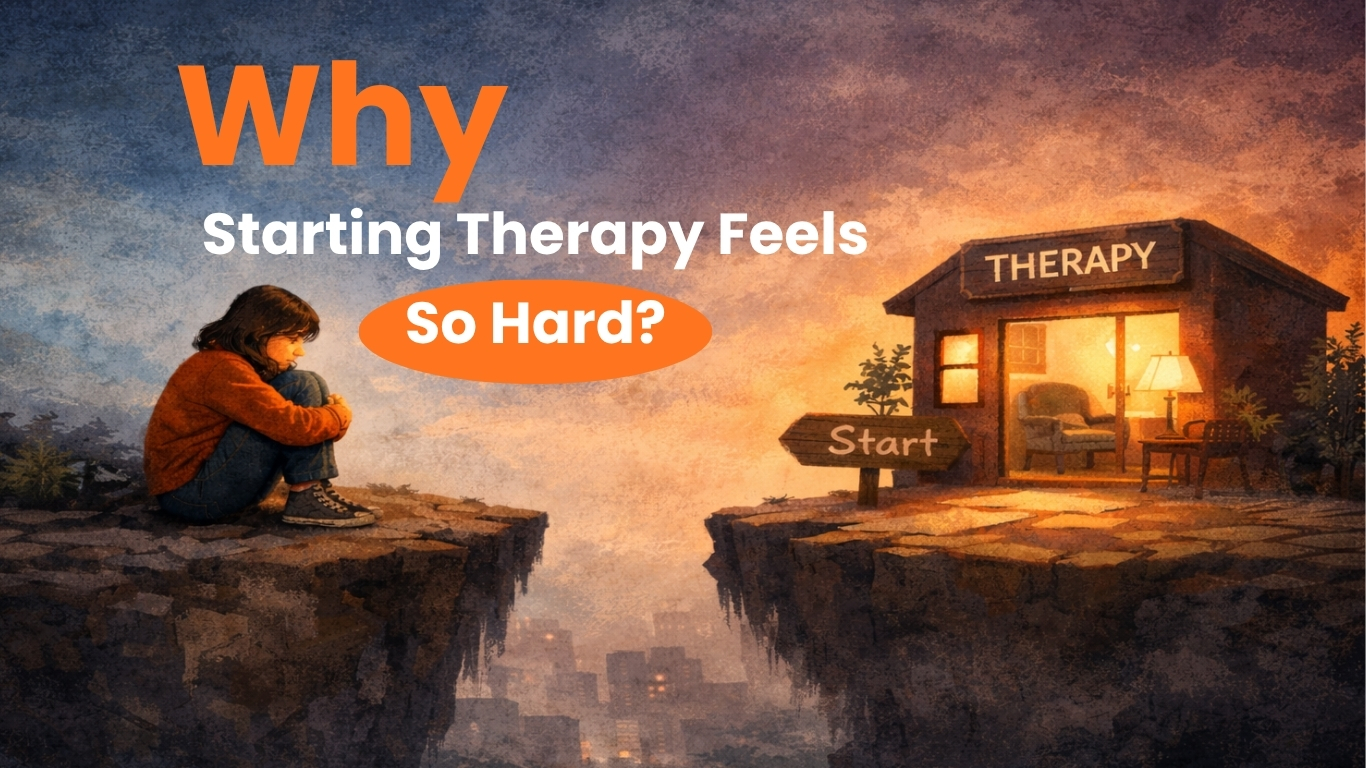
It’s a strange place to be in - knowing that something could help you and still not taking the step towards it. You have maybe thought about therapy before. Maybe even looked up a few therapists. Opened a tab. Read a bio. Closed it again. It’s not that you don’t believe it helps. You do. You just...haven’t gone.
In this process, there are also certain statements that you might repeat to yourself -“Maybe I don’t need it that much.”
“I’ll go when things get worse.”
“Do I really need to pay someone to tell me what I already know?”
And so you wait. For things to get clearer or for things to get worser. But in the meantime, nothing probably changes.
So the question isn’t always “Why don’t people go to therapy?” A more honest question might be - why does starting feel so difficult, even when we know it could help?
And maybe, in that space of hesitation, there are certain ideas about therapy that make starting out feel harder than it needs to be.
What happens when you decide to start therapy?
From an early career therapist perspective - Starting therapy isn’t just a step you take but a process that begins.
And it’s new. Not just for you, but in a way, for the therapist too.
Because no matter how many people they’ve worked with before, they haven’t worked with you. Your experiences, your patterns, your way of making sense of things. This is unfamiliar territory for both of you.
So the first few sessions aren’t about “getting it right.” They’re about figuring things out. Together.
What the First Session might feel like?
There’s often an expectation that the first session will bring immediate clarity.
That you’ll walk in, say everything that needs to be said, and walk out feeling lighter. But it rarely works that way.
The first session is usually slower. Sometimes a little awkward. There might be questions about you, your life, what brings you here. Some easy to answer, some not.
You might find yourself wondering if you’re “saying the right things.” Or if what you’re sharing is even important enough.
And at the same time, you’re also noticing -
How does it feel to sit here?
Does this person feel easy to talk to?
Can I be a little more honest than I usually am?
It’s less about solving anything in that moment, and more about beginning to understand if this can become a space where something can unfold.
First Session From the Other Side of the Room
From a therapist’s point of view, the first session isn’t about figuring you out. It’s about meeting you.
There’s no expectation that you’ll have the right words, or a clear story, or even a specific reason that sounds “valid enough.” In fact, most people don’t.
What we’re often paying attention to isn’t just what you’re saying but how you’re experiencing being there. Not to analyse you in a clinical way, but to understand your rhythm. Your pace. What feels easy, and what doesn’t.
There’s also an awareness that this might not feel natural to you yet. That it can take time to get used to sitting with someone who is really listening without interrupting, without jumping in, without telling you what to do. So there’s no rush.
We’re not looking for breakthroughs in the first session. We’re looking for the beginning of something much simpler - a sense of safety, even if it’s just a small one.
And just as you’re trying to understand if this space feels right for you, we’re also gently attuning to what might help you feel a little more at ease here.
It’s less about assessment in the rigid sense, and more about understanding how to meet you where you are.
Debunking Certain Myths and Expectations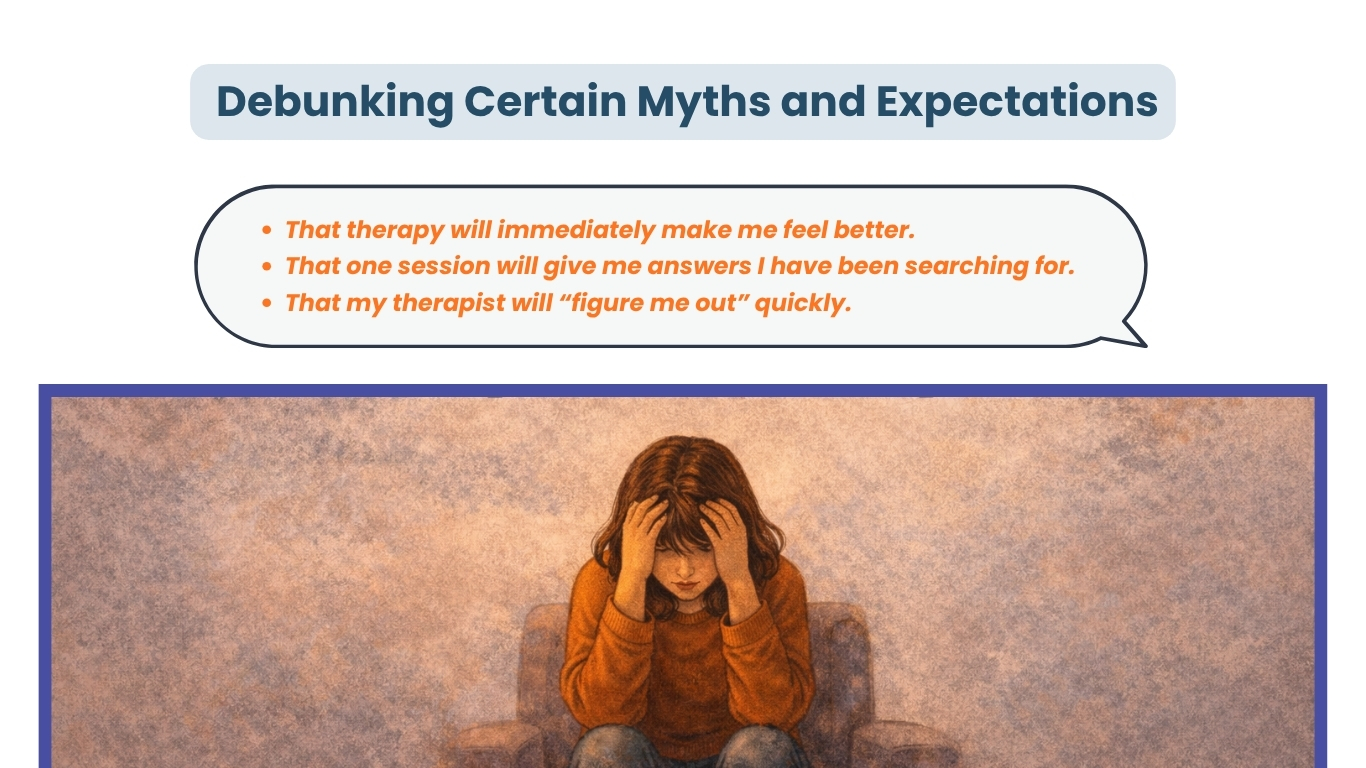
And in all of this, there are also certain expectations like -
That therapy will immediately make me feel better.
That one session will give me answers I have been searching for.
That my therapist will “figure me out” quickly.
But therapy doesn’t really work the way we hope it will. And maybe that’s the part that’s hardest to accept.
It has its own pace and it doesn’t rush just because we want relief to come quickly.
Some days, you might leave a session feeling lighter, like something has softened. And some days, you might walk out feeling like more has been stirred up than settled.
And that can feel unsettling. Even disappointing.
But unfortunately (or fortunately) that is the process.
Because therapy isn’t a quick fix or a magic pill. It doesn’t take things away overnight.
If anything, it asks you to stay with what you’ve been trying to move past - to sit with it a little longer, understand it a little deeper, and slowly make sense of it in a way that actually holds. And that takes time. Which can be frustrating, especially when something has been weighing on you for a while and you just want it to feel easier.
But most of what brings people to therapy didn’t appear all at once. It is built up quietly, over time, through adverse experiences, patterns or ways of coping.
So it makes sense that understanding it, and changing your relationship with it, doesn’t happen all at once either right?
It is a choice, a difficult but a crucial one, to keep showing up - even when it feels slow and even when it’s unclear.
Because more often than not, that’s where the change happens!
To conclude, you have already taken the time to carry what you’re carrying. To sit with it, work around it, make sense of it in the ways you knew how.
And if you’ve found yourself thinking about therapy before - opening a tab, reading a little, then closing it again - maybe this is something you can come back to it.
Maybe this time, starting therapy doesn’t have to feel so far away.